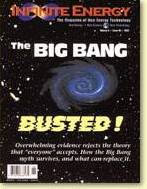
|
Breaking Through Editorial: The Implications
of the "Big Bang"
Published in IE Volume 8, Issue
#46, November/December 2002
by Eugene F. Mallove
A
long time ago, in a life before cold fusion and new energy, I published
a book, The Quickening Universe: Cosmic Evolution and Human Destiny (1987),
a portrait of our universe as I then understood it. This, my first
book, was based on the collected wisdom of the cosmologists and
biologists whom I had studied and believed. I now reject that tidy
picture, which rested on what I then thought was a sound theoretical
framework underlying the basic "Big Bang" cosmology, one based on
multiple interlocking streams of experimental evidence. I am still
proud of my synthesis of those days, so we still distribute The Quickening Universe, but with the following
caveat affixed to the inner cover. This is evidence of a capacity
to evolve, to move on:
Dear Reader:
Any author of a "cosmological philosophy" such as The Quickening
Universe is duty-bound to re-evaluate his reflections and former
"certainties" in light of new information. As you will read in the
Preface to this 1987 work, I wondered ". . .what the volume's sequel
would reveal if I were fortunate enough to be able to set it down
in 2010." It is not quite 2000 as I write this introductory note,
but already I can say that there is so very much that I did not
know in 1987 that would now have to be incorporated into a 2010
edition.
First, the low-energy nuclear reaction revolution (a.k.a. "cold
fusion") that emerged in 1989 and thereafter, in which I became
deeply involved as a writer and researcher (e.g. Fire from Ice: Searching for the Truth Behind the Cold Fusion Furor,
1991), was totally unexpected. The results to date potentially change
scientific conclusions in virtually every field-including biology,
but especially physics and chemistry. Second, in view of my learning
first-hand about the astonishing resistance of the scientific establishment
to radically new phenomena that have been conclusively demonstrated
in the laboratory, I have been moved to explore other heated controversies
in science in which paradigm paralysis may have played a role. I
conclude that there is a huge area of possible scientific revisionism
that would have to be applied to the edition of 2000, let alone
that of 2010!
However, since a complete rewrite for 2000 was not in the cards,
let me say that I am very proud of my synthesis of diverse branches
of human knowledge in 1987. I still hold to a model of a universe
coming to life- quickening- as a forced process from the basic physical
"laws." What those physical laws really are and what has been their
history of operation in this and other parts of the universe is
much less clear and certain to me in 1999 than it was in 1987. And,
I am no longer sure that these "laws" have much to say about proscribing
certain transcendent phenomena that are glimpsed in the laboratory
even today [Note: I was thinking of the work of Prof. Jahn and others
at Princeton.-EFM]. I believe that I was then a 40 year old child
who has grown up. I apologize for some of the excess-certainty and
dogmatism that you will find on these pages, but please do enjoy
your tour through The Quickening Universe. Learn about what
you may yet become.
-Dr. Eugene F. Mallove (July, 1999)
I have come to realize that there are many reasons to reject
the Big Bang, almost all having to do with the manner in which
the physics community misrepresents fundamental data, which it
claims supports the Big Bang. That misrepresentation is identical
in character with its single-minded certainty, to cite one prominent
example, that low-energy nuclear reactions (LENR) are impossible
and that all data seeming to support LENR must be rejected. We
are honored to be able to publish astronomer Dr. Tom Van Flandern's
annotated list of reasons to reject the Big Bang (p. 10). He draws
the following conclusions, with which I agree:
The Big Bang, much like the Santa Claus hypothesis,
no longer makes testable predictions wherein proponents agree
that a failure would falsify the hypothesis. Instead, the theory
is continually amended to account for all new, unexpected discoveries.
Indeed, many young scientists now think of this as a normal process
in science! They forget, or were never taught, that a model has
value only when it can predict new things that differentiate the
model from chance and from other models before the new things
are discovered. Explanations of new things are supposed to flow
from the basic theory itself with, at most, an adjustable parameter
or two, and not from add-on bits of new theory. . .Perhaps never
in the history of science has so much quality evidence accumulated
against a model so widely accepted within a field. Even the most
basic elements of the theory- the expansion of the universe and
the fireball remnant radiation- remain interpretations with credible
alternative explanations. One must wonder why, in this circumstance,
four good alternative models are not even being comparatively
discussed by most astronomers.
To glimpse how solidly the current Big Bang view is
accepted by the mainstream, let me quote Princeton University cosmologist
P. James E. Peebles, in his introduction to Scientific American's
"Special Edition: The Once and Future COSMOS" (2002, on newsstands
until 2003). After a brief overview of "evidence," which supposedly
supports the Big Bang, he writes: "I compare the process of establishing
such compelling results, in cosmology or any other science, to the
assembly of a framework. We seek to reinforce each piece of evidence
by adding cross-bracing from diverse measurements. Our framework
for the expansion of the universe is braced tightly enough to be
solid. The big bang theory is no longer seriously questioned; it
fits together too well. Even the most radical alternative- the latest
incarnation of the steady state theory- does not dispute that the
universe is expanding and cooling. You still hear differences of
opinion in cosmology, to be sure, but they concern additions to
the solid part."
It seems that Dr. Peebles has cross-braced himself
right into a tight paradigm box from which he cannot escape! And,
he marginalizes the best critics of the Big Bang, such as astronomer
Halton Arp, Tom Van Flandern, and others, by failing to mention
that they even exist. Only "differences of opinion" on the details
of the Big Bang are allowed. This is analogous to a hot fusion researcher
claiming that only "differences of opinion" exist on how to build
the next hot fusion reactor experiment, while ignoring that a fundamentally
different approach to generating fusion-scale energy from hydrogen,
LENR (a.k.a. "cold fusion'), has been discovered and proved. The
most significant implication to be gathered from the ascendancy
of the Big Bang- some have called it the "cult of the Big Bang"-
is that the process of science has broken down, particularly
within physics.
We need not review all the reasons to reject the Big
Bang-we leave that to Dr. Van Flandern and others-beyond mentioning
that many early twentieth century and present explanations for the
cosmic background radiation exist that have nothing to do with a
Big Bang, that photographic and radio telescope evidence exists
to challenge the very basis of the expanding universe (the interpretation
of galactic redshift as cosmic expansion), or that cosmic light
element distribution data have literally been fudged into
agreeing with an early hot universe Big Bang theory. That's enough!
Yet, one idea that Big Bang cosmologists propose must
indeed be correct, but not in the manner that they think. It is
well-known that contemporary Big Bang cosmology requires an intimate
blending of the microcosm of particle physics and fundamental forces
with the features of the macrocosm- the present universe of
galaxies, quasars, radiation, and whatever else ("dark matter,"
"dark energy," "quintessence,"?). How did these particles and forces,
as conceptualized by the mainstream, emerge from that hot, concentrated
early universe- at the supposed origin of "spacetime" itself from
a microscopic "singularity" of some kind?
Alternative cosmologies that view the universe being
perhaps infinitely old- with no beginning and probably no end- must
deal as well with the origin and destruction of particles of matter,
in whatever cataclysmic or benign processes may be hypothesized.
This process of creation and destruction may be occurring everywhere
in the universe in processes that have heretofore escaped our notice,
and/or at particular sites of violent cosmic eruptions, such as
from within the cores of galaxies. And, if besides matter and radiation
there should be a cosmic fine-structured aether associated with
space and time (whatever its physics), there must be a physics for
the origin and evolution of mass-bound particles from that aether.
The only other generic alternative to aether-emerging particles
(apart from the Big Bang), is that they were created de novo,
perhaps by some transcendent power (God), as many may wish to believe.
I should hasten to add that a liberal interpretation of the biblical
Genesis story of the Judeo-Christian tradition need not
depend on Big Bang cosmology. It is abundantly clear that our Sun
and its planetary system had to have had a multi-billion-year process
of origin from a cosmic plenum of some kind.
The implications for new energy science and technology
of non-Big Bang cosmology are profound, which is precisely why studying
the arguments for and against the Big Bang is so important. Cosmology
is not merely a luxury to understand our ultimate origins, so that
we may be either philosophically or emotionally pleased or displeased!
If we view the present condition of matter as winding-down- decaying
toward some ultimate oblivion, as the Big Bang would have one believe-
we are forced to conceptualize matter in the way that the so-called
Standard Model of elementary particles and forces allows. This model,
I am reasonably convinced, does not even allow for the kinds of
evidence that is being found today in LENR experiments, not to mention
even more provocative devices and tests that imply an extraction
of energy from the plenum of space itself (aether or "ZPE"). And,
the Standard Model, with Special and General Relativity as its conceptual
framework, does not seem to have even a clue about the true nature
of gravity.
So, what cosmology and physics could replace the Big
Bang? That is a tall order, demanding enough that it should be left
perhaps to a far future issue of Infinite Energy. But it
would be unfair, in closing, not to characterize some of the non-Big
Bang cosmological models that have been put forth:
. Quasi-Steady State Cosmology (F. Hoyle, G.
Burbidge, J.V. Narlikar, 2000): Creation of new matter occurs in
"little bangs" (or "mini-creation events") in the cores of galaxies-
matter that is ejected from galactic nuclei as quasars. The universe
is infinitely old.
. Plasma Cosmology (E.J. Lerner, 1991): An
infinite universe evolving over infinite time, with dominating electromagnetic
effects of interacting plasmas (rather than gravitation) forming
galactic and large-scale structures.
. Meta Model Cosmology (T. Van Flandern, 1999):
"A new cosmological model of the universe, arrived at deductively,
in which the universe is infinite in five dimensions and filled
with substance at all scales. In it, gravitation produces the redshift
of galaxies, is limited in range, and is produced by the pushing
action of tiny agents on matter."
. Variable Mass Cosmology (H. Arp, 1998): A
non-expanding universe that is indefinitely large and indefinitely
old. "Objects are continually being born and are growing, but are
somewhat different in each generation." High red-shifted objects
are young because they are born of newly created matter in which
particles, such as electrons, have very low mass, which increases
with time.
. Universe Cycle Model (A. Gulko, 1980s): Each
galaxy undergoes separately a cyclic process of birth, growth, aging,
death, and rebirth within an infinite universe. Quasars are stages
of galactic evolution prior to formation of a normal galaxy.
. Aetherometric Model (P. Correa and A. Correa,
2002- partially published): The universe is infinitely old; time
and space manifolds are separate. The spectrum of a microwave cosmic
background radiation is quantitatively explained in detail by the
continuous cosmological formation of electrons (and attendant gravitons)
from the aether. Part and parcel of an aether physical process that:
". . .converts free, nonelectric, nonelectromagnetic, nongravitic,
'latent thermal' or 'antigravitic' massfree energy into ORgone energy,
or ambipolar electric radiation and, in the process, also converts
other elements of the free nonelectric Aether into mass-energy (and
thus monopolar electricity) and into gravitational energy."

|
|